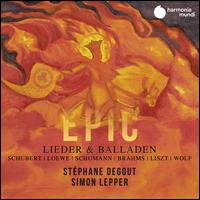
Baritone Stéphane Degout has mostly specialized in French music until now, but here he essays German (and Italian-language works) as though to the manner born, and offers a program that the 19th century would have found familiar, but that these days, qualifies as genuinely fresh. The title Epic indicates that the program consists (at least mostly) of storytelling songs and Degout understands that the point of these is for the singer to compel the audience's attention. He has a good deal of intensity in his top register, and ... Read More
Baritone Stéphane Degout has mostly specialized in French music until now, but here he essays German (and Italian-language works) as though to the manner born, and offers a program that the 19th century would have found familiar, but that these days, qualifies as genuinely fresh. The title Epic indicates that the program consists (at least mostly) of storytelling songs and Degout understands that the point of these is for the singer to compel the audience's attention. He has a good deal of intensity in his top register, and this is all to the good. He also offers songs that are not always in general circulation. Schubert's Der Zwerg, D. 771, is a supernatural cousin to Erlkönig, D. 328, not nearly as well known but very nearly as good. Degout proceeds to Schubert's little-known contemporary Carl Loewe, Schumann, Brahms, Hugo Wolf, and Liszt, who is represented by several songs, including the gloriously over-the-top Es war ein König in Thule, S. 278/2. The program ends with three of Liszt's Tre Sonetti... Read Less